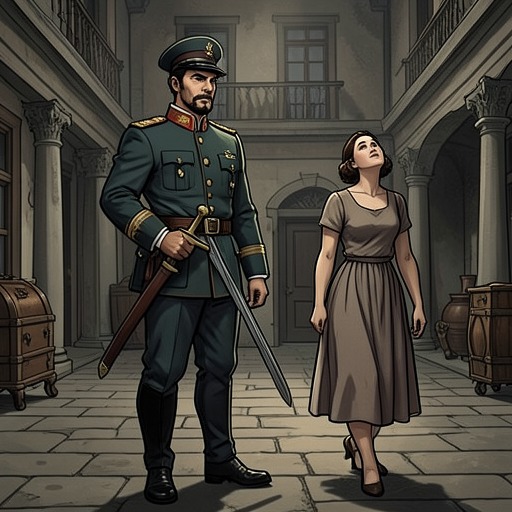
Roxane’s failed attempt to keep Christian from the war
Cyrano de BergeracRoxane’s failed attempt to keep Christian from the war is shaped by a contest between personal appeals and military orders. She tries to affect who will march to Arras by appealing to Count de Guiche, but the action turns toward departure: an order is produced, Christian is told to carry it, and Roxane is asked to bid her bridegroom farewell. The siege’s hunger and precarious defenses make that departure more than a private disappointment; it leads into a military crisis in which neither affection nor clever maneuver can remove the danger.
Roxane’s Proposed Strategy
Roxane’s conversation with Count de Guiche is framed around how best to wound Cyrano de Bergerac. She rejects the idea of putting him in the thick of the fighting: such a post, she argues, would suit him too well. Instead, she proposes that when the regiment marches to Arras, Cyrano be left behind with his beloved companions, the Cadets of Gascony, inactive for as long as the war lasts. Her tactic depends on knowing Cyrano’s character: battlefield danger would gratify him, while enforced absence from his companions would frustrate him.
The proposal gives Roxane leverage by presenting military assignment as a personal punishment. Rather than ask openly for a reprieve, she describes the posting that would most irritate Cyrano and invites De Guiche to use it. Yet the exchange also makes the limits of that strategy visible. The decision concerns a regiment’s movements and a war; Roxane can try to shape the choice through De Guiche, but she does not command the order that determines who goes.
The Order and the Farewell
De Guiche singles out a paper as the order concerning the Cadets and puts it in his pocket. Later, he draws out the paper he had kept and tells Christian, addressed as Baron, to carry it quickly. The sequence connects Roxane’s intervention to an actual military document, but the order’s precise terms are not stated in these moments. The action therefore turns on what can be seen: a paper is retained, then produced for Christian to bear, making military authority tangible in the midst of personal negotiation.
Roxane is then told to bid her bridegroom farewell. That instruction gives the scene its decisive reversal: Christian is not kept safely outside the movement toward war. The departure is not narrated as a long discussion or a negotiated consent; it arrives as an immediate command, paired with a farewell. Roxane’s attempt to influence events has not secured the outcome she wants, and the intimacy of the address to Christian sharpens the cost of that failure.
Cyrano, meanwhile, draws De Guiche further away by describing a contrivance for generating wind and rarefying air inside a cedar case using mirrors arranged in an icosahedral form. The technical explanation belongs to the same atmosphere of maneuver and delay: while military decisions are being made, Cyrano occupies De Guiche with an elaborate account. The passage does not establish that this diversion changes the order or prevents Christian’s departure; its importance is the contrast between Cyrano’s ingenuity in conversation and the force of the document that Christian is told to carry.
The Siege’s Material Stakes
The later reports from Arras clarify what the march entails. Carbon calls it disgraceful that the besiegers should themselves be starving. Le Bret describes the complication of the siege: the French are conducting a siege while also being trapped and besieged by the Cardinal Infante of Spain. War here is not an abstract test of courage but a condition of encirclement and deprivation.
De Guiche reports that the Marshal made a final, secret effort to bring provisions, taking a substantial force with him; half the army is consequently absent from camp. The information exposes a further vulnerability: an attempt to relieve hunger has also reduced the force left behind. Roxane, arriving amid this precariousness, says that the camp air is keen and that she herself is famished, then asks for pasties, cold fricassee, and old wines. Her demand brings food into the foreground as a practical need at a camp whose men have already been described as starving.
De Guiche says that he has one cannon left and that it has been carried to a corner for the men to use if necessary. The remaining gun is a concrete measure of how thin the defenses have become. These details do not show that Roxane’s earlier maneuver caused the shortages or altered the siege; they establish the conditions under which Christian’s movement toward the war matters. The military order leads into a setting where provisions, absent troops, and limited weapons shape the immediate stakes.
Significance of the Failed Intervention
The episode places Roxane’s intimate knowledge of Cyrano beside the impersonal force of military procedure. Her proposed punishment is psychologically precise: she believes Cyrano would welcome the thick of the fighting and would suffer more from being left behind. But the scene’s decisive objects are not her arguments; they are the order in De Guiche’s pocket and the command that Christian carry it. The paper converts conversation into action and brings the farewell into the foreground.
The contrast also prepares the siege narrative’s central pressure. Personal loyalties continue to matter—Roxane is asked to say farewell to her bridegroom, and Cyrano’s companions are part of the very posting she describes—but they operate amid starvation, encirclement, troop movements, and dwindling artillery. The attempt fails not through a stated explanation of every decision, but through the visible outcome: Christian is sent onward, while the danger at Arras remains.